

If you were wondering why your rating changed for the Chicago Mac or another major ORC race, here is the explanation.
The Chicago to Mackinac Race has been run under several handicap rules over the years, switching to the current ORC system in 2021 alongside the Bayview to Mackinac Race. Over the past five years, the Chicago Mac Race Committee has had the ability to select from different scoring options: downwind, all-purpose, or the more recently added upwind wind mixes. These were chosen based on the expected conditions leading up to the race. This year, however, if you looked at the rating used for scoring, you would not find it on your ORC certificate. Instead, you would see WRS, or Weather Routing Scoring, listed in the results. This was especially noticeable in the Cruising Division, where the resulting ratings differed significantly from the standard wind mixes used in previous years.
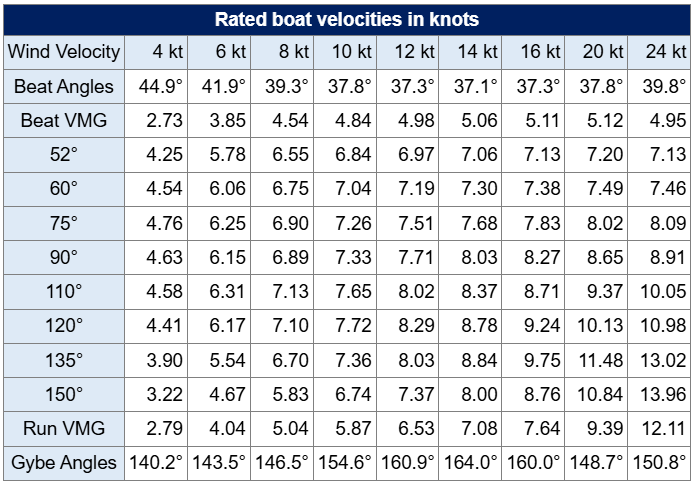
Table of predicted boat speed based on conditions
To understand Weather Routing Scoring, it helps to first understand how ORC works. ORC is a measurement-based system that predicts boat speed using a Velocity Prediction Program (VPP). The VPP generates a table of roughly 90 data points that estimate boat speed across different wind speeds and angles. For example, it might predict a VMG of 4.5 knots upwind, or 7 knots at 100 degrees true wind angle in 12 knots of breeze. These data points are then used to create a range of ratings, each corresponding to different conditions. Final race ratings are derived from weighted averages of these points based on expected wind conditions, allowing for everything from all-purpose ratings to more specialized reaching or running mixes, and even custom mixes tailored to specific races.

Table of each of the individual rates for difference conditions in Time on Distance
Since adopting ORC, the Chicago Mac has used its own custom wind mixes. Until this year, these were selected before the race, with the Race Committee choosing the mix that best matched the forecast. Were these mixes an exact match for what actually happened on the racecourse? Rarely. But they generally provided a reasonable approximation of typical Chicago Mac conditions.
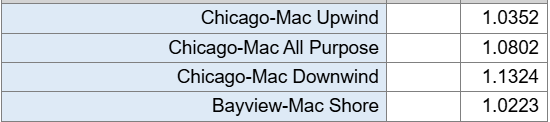
Mackinac specific ratings based on a custom wind mixes based on historical data
This year introduced Weather Routing Scoring. WRS comes from a partnership between ORC and PredictWind, using routing software to simulate how each boat would sail the course. Each boat’s individual ORC polars are fed into the model, which then generates a predicted route based on forecast weather data. From this, a custom wind mix is created not just for the race as a whole, but for each individual boat. The goal is to improve accuracy by accounting for differences in weather across the course and over time. If you have ever been in a race where the larger boats finish in pressure and the wind shuts off before the smaller boats arrive, you understand the problem WRS is trying to solve.
There is one glaring issue. The wind mix it creates is perfect for the forecast, and that is the problem. On the Great Lakes, forecasts can be inconsistent and local effects are significant. WRS is a powerful tool in venues with stable, predictable conditions, such as trade wind environments, but the Great Lakes are not that. Forecast accuracy is lower, and small errors can quickly compound.
If the forecast is wrong, the derived ratings are wrong, and as the race progresses those errors can grow. For example, if the wind is lighter than expected on day one, or shifts just enough to turn a reach into a beat, boats will end up in different positions than the routing predicted. By day two, even if the forecast improves, the boats may be in entirely different parts of the lake than expected, sailing in completely different conditions than the model assumed.
There is also a more subtle issue. ORC tends to perform best when ratings are based on a broader mix of conditions. Averaging across multiple wind speeds and angles smooths out extremes. When you narrow the rating to a very specific condition, such as light-air running or heavy-air reaching, differences between boats become more pronounced. Some boats excel in those conditions, others struggle, and the system becomes more sensitive and less forgiving. In other words, the more specific the wind mix, the greater the spread in performance, and the harder it is for the rating system to remain consistently accurate.
Running races and managing rating systems is not easy. It is often a thankless job, and the people who do it deserve a lot of credit. No matter what system is used, someone will win and most of the fleet will feel like it could have been fairer. For offshore races in particular, there is always a balance to strike between transparency, with a known rating before the start so competitors can race to a number, and theoretical accuracy using tools like WRS that depend heavily on forecast quality.
Weather Routing Scoring is a meaningful step forward in how offshore races can be scored. In the right conditions, it has the potential to produce more accurate and fair results by accounting for how each boat actually experiences the race. But like any model, it is only as good as its inputs. On the Great Lakes, where forecasts can shift and local conditions play a major role, that introduces a level of uncertainty that can outweigh the theoretical gains in precision.
At least for now, WRS feels less like a definitive solution and more like another tool in the toolbox. It may prove to be the future of offshore scoring, but in venues like the Great Lakes, there is still a strong case for the broader, more averaged wind mixes that have historically provided consistent and understandable results.