
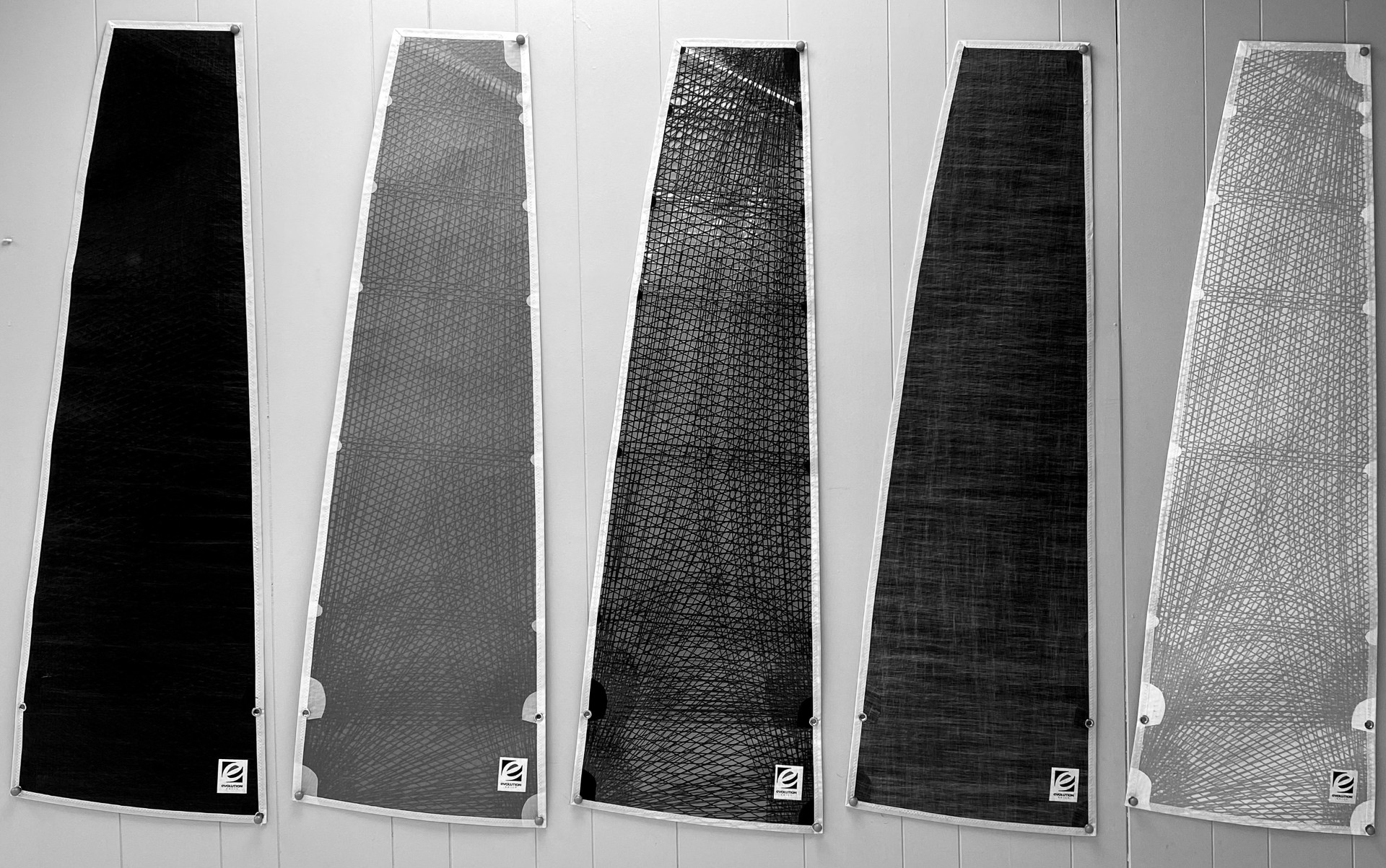
Every sailcloth we work with comes in a wide range of weights so we can match the material to the boat, the sailing conditions, and the role of the sail in the inventory. The displacement of the boat, expected sailing locations, and whether a sail is intended as a light-air specialist, a heavy-weather sail, or an all-purpose workhorse all influence how heavy a cloth we choose.
One of the confusing parts of sailcloth selection is that weight and strength are expressed in different ways depending on the material, manufacturer, and even the country where the cloth is produced. Let’s break down the most common systems, starting with woven sails.
Woven Sailcloth (Dacron)
Dacron is the most common sailcloth used for cruising sails and many racing sails. Traditionally, Dacron weight is expressed in ounces, but not ounces per square foot or square yard. Instead, it’s measured in “sailmaker’s ounces,” commonly abbreviated as SM oz.
A sailmaker’s ounce refers to the weight of a piece of cloth measuring 36 inches by 28.5 inches. This dates back to when sailcloth was commonly sold in 28.5-inch-wide rolls. For example, a cloth like Challenge Newport AP might be offered in 6.45 oz, 7.45 oz, and 8.45 oz versions.
Interestingly, the numbers after the decimal point do not always correspond exactly to the true physical weight of the cloth. Instead, they often indicate the product family or weave style. For example, Contender Dacron clothes ending in .45 are part of the Newport AP line, while cloths ending in .1 belong to the Newport Pro Radial line. The actual weights are generally close to the labeled values, but not precise to the decimal.
Sometimes you’ll see multiple suffixes within the same cloth line. This usually indicates a secondary weave variation. Staying with the Newport AP example, clothes ending in .95 are higher-aspect versions that are slightly stronger in the fill direction (vertical loads). These function like half-steps in weight and are well suited for taller, narrower sails where additional vertical strength is beneficial.

Metric Weights (Grams per Square Meter)
If a sailcloth supplier is based in a region where the metric system is standard, cloth weights may be expressed in grams per square meter (gsm). A common example is Dimension-Polyant’s Hydranet line, which includes fabrics such as Hydranet 303, 343, and 393. Dimension Polyant generally uses the last digit to signify the cloth type, similar to the suffixes on SM OZ.
In this system, each step is typically about 40 grams per square meter, which works out to roughly one sailmaker’s ounce. While the units differ, the concept is the same: higher numbers indicate heavier, stronger cloth intended for larger boats or more demanding conditions.
Spinnaker Cloth Weights
Spinnaker cloth has its own set of quirks. Much of the traditional naming comes from the weight of the raw nylon yarn before resin treatment and heat shrinking. As a result, the commonly used names don’t always match the finished cloth weight.
For example, what is typically called a three-quarter-ounce (¾ oz) spinnaker cloth actually weighs around 0.9 SM oz, while an “ounce and a half” cloth weighs closer to 1.8 SM oz. Manufacturers usually provide spinnaker data in both sailmaker’s ounces and grams per square meter, just like Dacron.
To add another layer of complexity, different manufacturers use different naming conventions. Bainbridge’s AirX and Contender’s SuperKote and SuperLite lines use similar labels that don’t always correspond directly. For instance, AirX 600 and SuperKote 60, often referred to as “.6-ounce kites,” both weigh around 0.85 SM oz. However, SuperKote 90 is nearly half an ounce lighter than AirX 900, weighing about 1.1 SM oz versus 1.6 SM oz. This is why we rely on real weight data rather than names alone when specifying spinnakers.
Paneled Laminates
Paneled laminates introduce even more variation in naming. Some manufacturers stick closely to sailmaker’s ounces. Contender’s CDX Pro line, for example, includes CDX Pro 5, 6, and 7, which roughly correspond to increasing cloth weights.
Other lines simplify things by using descriptive categories instead of numbers. Dimension-Polyant’s DCX series uses designations like DCX-SL (super light), DCX-L (light), DCX-M (medium), and DCX-H (heavy), spanning roughly from 6.5 SM oz to 10.5 SM oz.
In cruising laminates, increases in cloth weight usually mean heavier outer skins and heavier internal fibers. As we move toward more performance-oriented laminates, another metric becomes important: DPI, or denier per inch. DPI refers to how much internal structural fiber is built into the sail. As DPI increases, the amount of internal fiber increases while the outer skins may remain unchanged. Materials like Carbon Sport or GPL follow this pattern, with higher DPI numbers indicating more internal structure and higher load capacity.
Composite and Membrane Sails
When we move into composite sails, such as our EM2 composite membranes, DPI becomes even more significant. Because the outer skins and internal fibers can be specified independently, the fiber density can be tuned precisely to the loads of the sail.
One of the major advantages of membrane construction is that fibers are placed only where they are needed. As a result, DPI can vary significantly across the sail. Most sailmakers measure DPI at the mid-leech, where fiber density is highest, to provide a consistent reference point.
The key difference between DPI in a paneled laminate and DPI in a composite membrane is flexibility. Laminates are produced in off-the-shelf options. For example, materials like Dimension-Polyant’s PX series may be available in 5, 10, 15, and 20 DPI. We can sometimes blend two or three cloth weights in a sail to land between those values, but the options are still limited.
With membrane sails, every sail is custom. Fiber type, density, and layout are tailored to the specific boat, sail shape, and intended use, allowing far more precise control over weight, stretch resistance, and durability.
Sailcloth weight is more than just a number on a spec sheet. It reflects how a sail will perform, how long it will last, and how well it will match a boat’s size, rig, and sailing program. Between sailmaker’s ounces, metric weights, naming conventions, DPI, and construction methods, it’s easy to see why comparing sailcloths can be confusing.
Our job is to cut through that complexity and select the right material for each sail, balancing performance, durability, and value. Whether it’s a traditional woven Dacron, a modern laminate, or a fully custom composite membrane, understanding how sailcloth weights work helps ensure you get a sail that performs the way it should, season after season.
For more information
Request a Quote
Quote
Learn More About Evolution Sails Chicago
Evolution Sails Chicago
Explore Our Learning Center
Learning Center
See Our J Boats Midwest Dealership
J Boats Midwest