

Why Mess With a Classic?
Changing an icon of one-design racing is considered blasphemy. The J/105 has had a strong, loyal following since the first boat launched in 1991, with over 600 boats built and active one-design fleets across the country. It was revolutionary when it was new: the first production boat to come standard with a retractable sprit. The clean design, tight class rules, and great racing helped the class explode.
So why are we messing with it?
The simple answer is fun is fast. The longer answer: the boat has a great hull but is under-canvased, and we sail primarily in a light-air venue. The J/105 was designed around a genoa, but that sail has long since been dropped from class racing, and we’ve learned a lot about asymmetrical spinnakers since the 105 helped bring them into the mainstream. Newer boats fly much larger kites now. That left the one-design configuration crushing it in big breeze but struggling in the light, even though the hull can clearly handle more sail area, especially downwind, where the flat bottom in the aft section and big rudder give it tons of control at speed.
From Lil Loki to Warlock
Like many boats, this one’s story runs through multiple owners and names. At various points it was called simply “370,” then Creative Destruction, then Convexity. We pick up the story when it was named Lil Loki and converted to a simple light-air flyer for local racing, with the family’s big sister Loki (a turboed J/121, later a Carkeek 46) handling offshore work. The plan was simple: put a bigger rig in the boat and keep the rest one-design. A gorgeous high-modulus carbon rig came from New Zealand, matched with a new paint job from Beasley Marine and a set of Element sails from Evolution, and the legend was born.
The original setup was built to win races in Charlevoix’s dying breezes. The power-to-weight ratio was off the charts: a massive genoa and spinnakers bigger than not just the one-design sails, but the J/111’s kites, by a good 10 meters. Man, did that boat rip. Starting to depower around 7 knots, it was a true light-air killer, and downwind it really lit up, proof the hull could handle the extra sail area. I got to hop on for a few beer-can races and see firsthand how well it went.
The boat didn’t do many events, but it posted straight bullets to win the Harbor Springs U Gotta Regatta. After a few seasons the owner was aging out of sailing, and Lil Loki was donated to Warrior Sailing. That’s when I got a call from Tom, asking what I knew about the boat. It was available for a good price, and an even better one if we could pick it up within a week. Tom and I quickly put together a plan, including a fallback to bring it back to one-design trim if the turbo package didn’t work out. Spoiler alert: that fallback was forgotten almost immediately.
One of the first races we ran was the Verve Cup distance race. We had a good start and held our own with the 40-footers, tight-reaching to the first mark, then rounded, popped the kite, and quickly hit 17 knots. By the time we were halfway down the leg, we’d left the fleet in our dust, and by the leeward mark Tom looked at me and said to rip up the OD plan; this was too much fun. By the end of the week, we were plotting how to set the boat up for ORC and win the Mac.
Refitting for the Mac
The boat went into the shed that winter and came back out with new halyards and tack points for the ORC setup. We dropped the genoa entirely for a J1.5 all-purpose jib, added a J0 for light-air upwind work and reaching, added both a spinnaker staysail and a genoa staysail for free, unrated sail area, and rounded out the inventory with a few heavy-air kites. Losing the genoa for the J0 improved our rating significantly without slowing the boat down, and in some conditions actually made it faster. The staysails let us load on more sail area; the boat seemed to skip right over displacement mode and glide across the water at 8 and 9 knots. In our first race with the new setup we had over 200 square meters of sail flying, roughly double what a stock J/105 carries with a main, jib, and kite.
The 2026 Mac
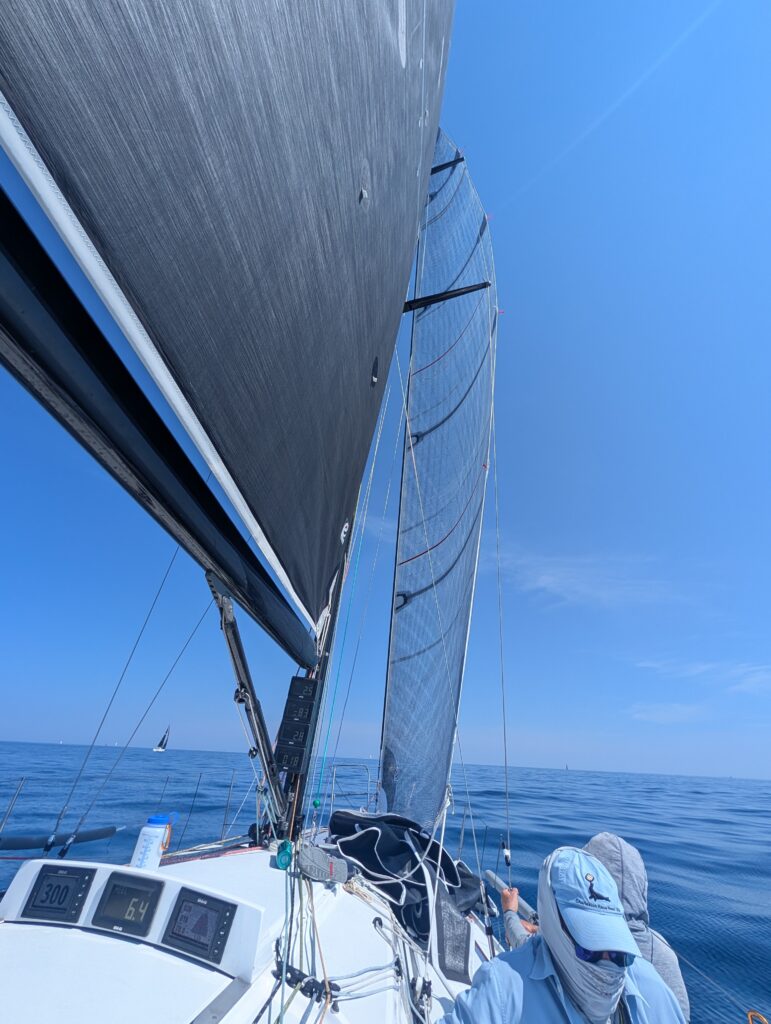
That whole project built toward the goal that mattered most to Tom: winning the one race that had eluded him, the Chicago to Mackinac Race. The 2026 race shaped up to be the perfect year for us, with the forecast calling for upwind in the first 12 hours, then a shift into 34 hours of running and reaching. At the start, I told the team we just needed to stay in touch upwind; we likely wouldn’t keep pace with the bigger, heavier boats in the fleet. If we could stay within 10 miles of the leader by the time the kites came out of the bag, we’d have a real shot at winning.
Well, we were just over 5 miles off the lead when the wind finally shifted Saturday night, though a ridge of light air still stood between us and the good stuff. Our toughest early call was whether to head in near Little and Big Sable Points or sail more distance to go offshore; we chose to head for shore and work the thermals. The outside route may have been slightly better, but our light-air performance with the drifter and J0 kept us moving. As we neared the turn at Point Betsie we started converging with the boats in front of us as the breeze filled in and went aft, and we had the better angle on port gybe coming off the shore, and a giant spinnaker up to drive the boat forward.
Begin the sleigh ride. The wind kept building through Sunday evening, and we engaged the thrusters, sitting casually at 11 and 12 knot averages, fully under control and flying over the waves. Every Yellow Brick report showed us clawing back tenths of a mile, until we drew even with the lead pack of Blondie and Archimedes III.
We weren’t out of the woods yet. A major squall line had built up north of the lake and was charging toward us, set to hit just before we rounded Point Betsie. We got the J3 on deck, stowed the staysails, threw a preemptive reef in the main, and got ready to drop the kite. The calm before the storm was massive, and we sat for five full minutes in dead calm before it hit. The squall brought high-30-knot gusts and a major shift, but we kept the boat pointed the right way and were quickly back on the A2, hauling the mail when the storm passed. Winds settled into the mid-20s and the boat came alive, and we entered the Manitou Passage with a solid lead and a favorable shift that lined us up nicely for the exit near North Manitou Lighthouse.
A second squall line was building over the north end of the lake, and this one looked bigger. We ran through the same prep, but our timing was off; the squall stalled, and we sailed under a reefed main and jib for half an hour before it finally hit, first with rain like I’d never seen, then wind. We hung on through an extended stretch of high-30s, low-40s, at times reaching off course to keep the boat upright. When it passed, we made the only real mistake of the weekend: we put the spinnaker back up and started ripping, a little too fast. The breeze built back to 15, then 20, then 25 knots, and I called for the takedown as we bounced over building, choppy waves. Just as we prepped to drop the sail, the halyard clutch let go without warning, and we found ourselves in rapidly building breeze with the spinnaker in the water, under the boat. For a brief moment we were over on our side with the kite pinned beneath the hull, and I thought I was watching the race slip away. We got extremely lucky; the sail passed clear under the boat without fouling the keel or rudder, and the team did an amazing job hauling it back in. With only a sacrificed tack line and a couple of tears in the A2, we were off again under main alone, doing a safety gybe, tacking through instead in the building breeze, to get back on course at 11 knots. We waited out the wind, put the A4 up in case of more surprises, and this time it had the opposite effect: the breeze eased into a manageable range, and a quick peel to the A1 kept us moving.
Crossing the Line
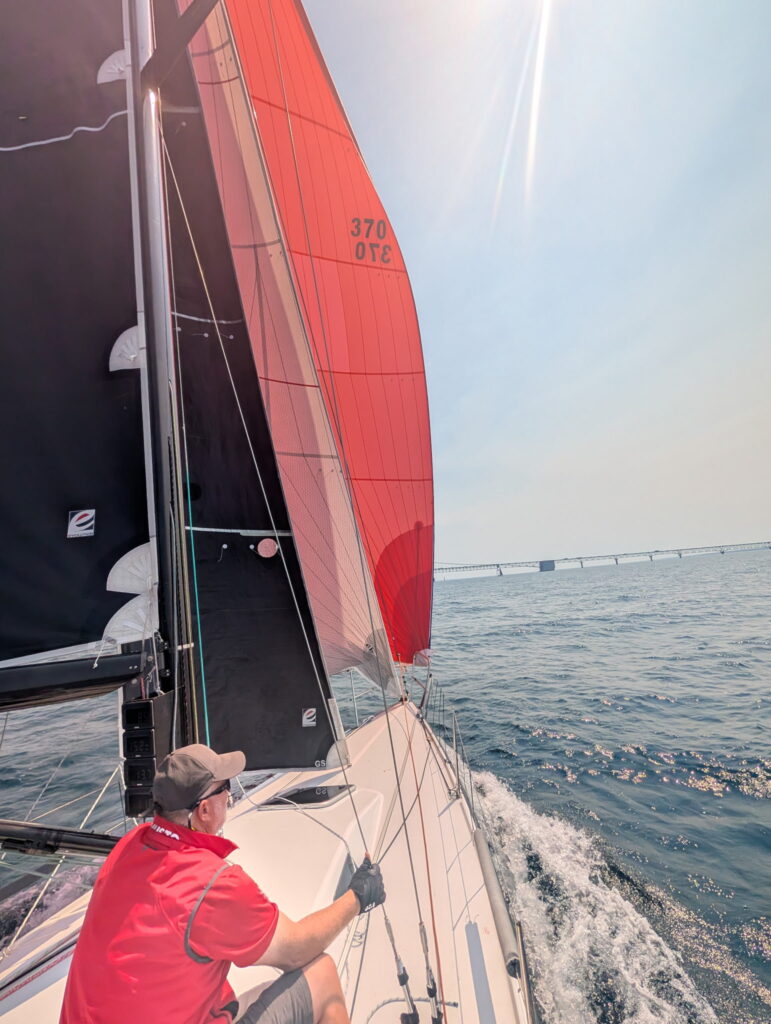
We came into Grays Reef Lighthouse with a solid lead and good breeze behind us. A couple of gybes lined us up with the passage, then a quick rounding of the green #3 can put us into the Straits of Mackinac with 13 to 15 knots. The final stretch was picturesque: spinnaker and staysails up, broad-reaching at 11 knots straight to the finish, with our closest competitor almost an hour behind and owing us time.
We crossed the finish line in fine form, sails flying: first in class, sixth overall. We only slipped a few spots in the overall standings when the smaller boats behind us got a late push from building breeze.
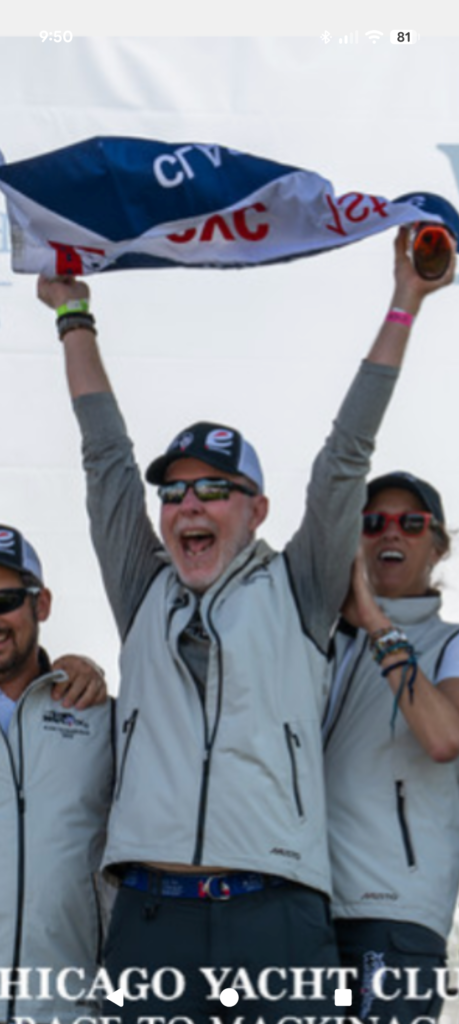
The customary celebration kicked off on the island, and the team got to savor a goal a couple of years in the making. I love watching these projects go from concept, to reality, to smashing their own targets. The boat and crew performed beyond expectations, and we’re ready for another run at it next year.
Thank you to Tom for trusting me to guide the project and for sticking with it through some early-season setbacks. And thank you to Brian, Joe, Meghan, Al, and Steve for pushing the boat all 333 miles.
More Information
Request a Quote
Quote
Learn More About Evolution Sails Chicago
Evolution Sails Chicago
Explore Our Learning Center
Learning Center
See Our J Boats Midwest Dealership
J Boats Midwest