
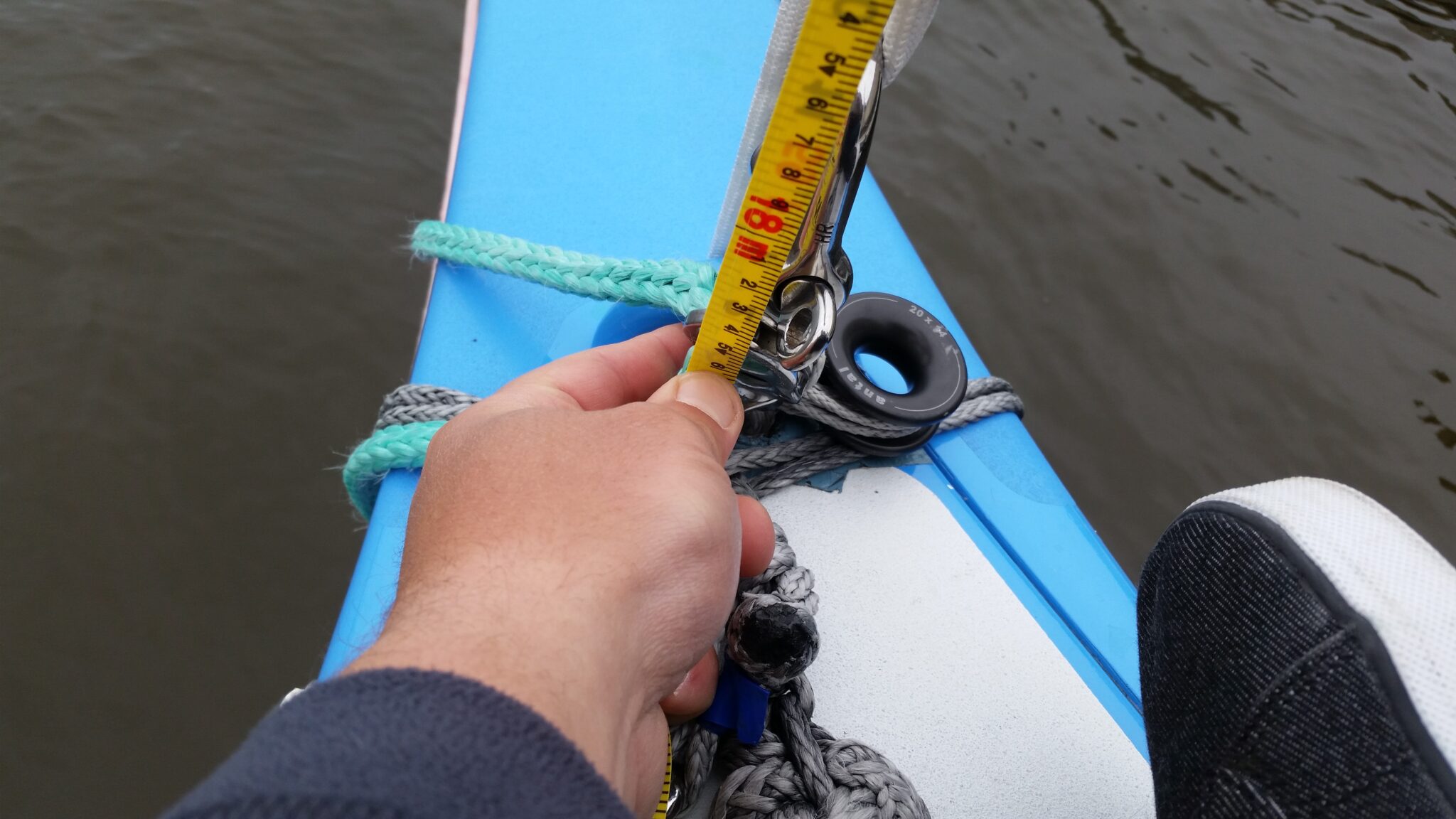
Back in Article 3 we talked about the designer dimensions, the I, J, P, E, ISP, and SPL measurements used to size your sails and generate a quote. Now that you’ve made your decisions and are ready to build, it’s time for the next step: actually measuring your boat. This is a more detailed process, and it’s what ensures the finished sail fits your specific boat properly rather than just a generic version of your model.
Why We Measure Again
If you’ve ever had a suit made to measure, you’ll understand the principle. The designer’s specifications tell us what the sail should be in theory. The actual measurements tell us what will work on your boat in reality. Even on a well-known production boat, there can be meaningful variation between hulls. Rigs get modified, booms get replaced, mast fittings change, and equipment gets upgraded over the years. Any of these can shift the numbers enough to matter when you’re building a sail that needs to fit precisely.
Beyond the primary dimensions, luff, leech, and foot, we also need to measure attachment points like tack shackles, reef hooks, and mainsail cars. Getting these details right is what ensures the sail not only fits but integrates properly with your existing hardware and setup.
What Gets Measured
The specific measurements vary depending on which sail is being built, but for a mainsail the key ones include the actual luff length from the boom to the top of the track or headboard position, the foot length from the tack to the clew point, and the distance from the gooseneck to the tack fitting. We’ll also note any mast bend or prebend, which we account for in the luff curve of the mainsail to ensure the sail sets correctly and the shape comes out as designed.
For a headsail the main measurements are the actual luff length available on the furler or forestay, the tack height off the deck, the sheeting position and track geometry on deck, and the distance from the forestay to the mast at deck level. These tell us exactly how the sail will sit on the boat and how it needs to be cut to sheet and trim correctly.
For downwind sails like spinnakers and code zeros, we’ll confirm the hoist height, the tack point position, and any bowsprit or pole dimensions that affect how the sail is flown. Beyond the basic dimensions, we also need to know about your furling gear, since the furler affects how the luff is constructed and how the sail deploys and douses. How the sail launches matters too, whether it’s flown from a fixed bowsprit, a retractable prod, or a simple bow fitting, since this affects the tack point and luff length. And finally, where the sail sheets to on deck affects the clew height and overall shape, so knowing your layout helps us design a sail that works with your boat from the start.

How We Get the Measurements
There are several ways we get to the right numbers, and we’ll work with you to figure out the best approach for your situation. Often it’s a combination of methods.
Measuring the boat directly with the rig up is the most thorough method. For customers local to us, we’ll often come to the boat ourselves to take measurements. This lets us see the full picture, including any unusual hardware, modifications, or deck layouts that are hard to convey in a description, and it gives us a chance to talk through any questions in person. For customers further afield we’ll provide a detailed measurement guide and walk you through exactly what we need. Many sailors are perfectly comfortable taking their own measurements with a tape measure and a bit of patience, and we’re available by phone or video call to help if anything is unclear. We can also arrange for a team member or trusted industry partner to visit the boat on your behalf, wherever you are. Just ask and we’ll figure out the best approach.
For many production boats we already have the measurements on file from previous builds. We maintain a deep database of sistership measurements, and if we’ve built sails for your model before there’s a good chance we can use that as a strong starting point. It’s important to verify the exact version of the boat though, since some models have multiple configurations that can affect fit. Even when we’re working from sistership data, we’ll typically use one of the other methods to confirm the key details, whether that’s a set of partial measurements from the owner, a check against an existing sail, or a combination of both. That cross-check gives us confidence that what we have on file is accurate for your specific boat before we start building.
Another option, particularly useful for new or custom boats, is working from a sail plan or rig plan provided directly by the manufacturer. As boat dealers ourselves we have strong relationships with most major boat builders and can often track down the plans when others can’t. This approach is especially common when sails are being ordered before the boat is even in the water. Nobody wants to splash a brand new boat and then wait another two months for sails to arrive, so building from the manufacturer’s plans lets us get a head start and have the sails ready to go from day one.
If the boat isn’t accessible, for example during the offseason or while it’s out of the water for repairs, we can also work from a sail plan provided by the designer. For older boats where plans may no longer reflect the current rig, or where the documentation simply isn’t available, we have other options.
One of those options is measuring an existing sail that fits correctly. A well-fitting old sail carries a lot of useful information about what works on that specific boat. Because sails stretch and distort over time though, we generally recommend sending the sail to our loft for precise measurement rather than measuring it on the dock. This ensures accuracy and prevents small errors from carrying over into the new sail.
Whatever method or combination of methods we use, we verify the numbers before anything gets cut. If something looks inconsistent or doesn’t match what we’d expect for that boat, we’ll reach out and sort it out before we start building.

A Note on Fit
A sail that fits well is a sail that performs well. The luff needs to load correctly on the furler or track, the foot needs to sit at the right height, and the clew needs to land in the right place for your sheeting angle. These aren’t minor details; they directly affect how the sail sets, how it trims, and how comfortable it is to use. Getting the measurements right is what makes all the decisions you’ve made through this process actually show up in the finished sail.
For a full overview of our measurement process, check out our detailed guide here: Getting Perfect Measurments
In Article 8, we’ll talk about what happens after you place your order, including what to expect while your sails are being built and how to plan for the lead time.