
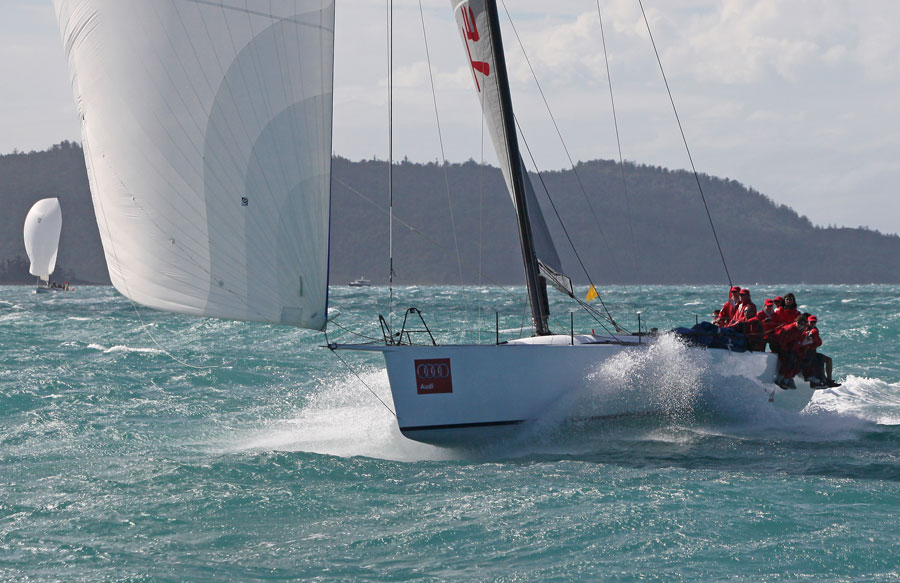
Sailing in waves is one of the most difficult skills to master, even for experienced sailors. This year on Lake Michigan has been an unusual one, with shifting wind patterns and confused seas that have made driving especially challenging. Most sailors have heard the classic advice for steering through chop: drive up into the face of the wave and down the backside, or simply “feel the boat” and let it carry itself through. These approaches work to a point, but there’s a more advanced way of thinking about steering in waves. Instead of focusing primarily on wave angles or telltales, the driver should concentrate on maintaining the correct heel angle and rudder load. When the boat is trimmed and balanced properly, it will steer itself through the waves with only minor input from the helm.
Every boat has an ideal heel angle for a given condition, usually somewhere in the mid-teens. At this sweet spot, the boat tracks with a few degrees of weather helm, enough for feel and control without adding drag. Too flat and the hull will pound into the bottom of the waves, making the ride slow and punishing. Too much heel, on the other hand, prevents the boat from releasing over the crest, causing it to slam awkwardly down the backside while skidding sideways. The goal is a balanced setup where the boat drives cleanly, the rudder maintains consistent pressure, and the driver isn’t forced into constant course corrections.
Achieving this balance requires communication between the driver and the trimmers. The driver should be the primary source of feedback, calling out whether the boat feels overpowered or underpowered. Trimmers then adjust the sails to deliver the correct feel. The driver’s focus should be on holding heel angle above all else, with waves considered next, and telltales as a distant third priority. If the perfect heel angle cannot be achieved while also keeping telltales flowing, that is the signal to adjust trim rather than for the driver to change course. The mainsail trimmer in particular plays a critical role, responding to the boat’s feel with sheet, traveler, and backstay so that the boat remains balanced and able to release cleanly off the tops of the waves.
Balancing the sail plan is especially important in bigger breeze, which is usually when wave steering comes into play. If the mainsail is constantly luffing just to keep the boat flat, it is better to add backstay or depower the jib rather than rely on the main alone. Moving jib cars aft to create twist helps the slot stay open, so that when the main is eased, the flow doesn’t choke. This adjustment is particularly important on boats with tight sheeting angles or inhaulers. If the boat is still overpowered after these adjustments—or if overbend wrinkles appear in the main—it is time to increase rig tension or reduce sail area by changing headsails or reefing. These are not signs of weakness, but of keeping the boat balanced so that the rudder can do its job efficiently.
When all of these pieces come together—correct heel angle, steady rudder load, proper trim, and open communication—the boat will naturally carry itself through waves with less drama. The driver is freed from fighting the helm and instead keeps a steady hand, applying only the small adjustments needed to follow the rhythm of the sea. The trimmers anticipate changes in power and keep the boat balanced, while the helm stays consistently loaded. It is this synergy, not brute force on the tiller, that allows a boat to drive smoothly and quickly in challenging wave conditions.
In the end, good wave steering is not about reacting to every crest and trough with dramatic helm movements. It is about setting up the boat so that it wants to sail itself, and then letting it do so. By focusing on heel angle and balance, and by keeping communication clear between helm and trimmers, you can transform the boat’s motion through waves from a struggle into a rhythm. Master this, and you’ll find yourself not only driving better in waves, but also sailing faster, more comfortably, and with greater control.
For more information
If you are interested in this article or would like a quote please reach out, we would be happy to help.
Request a Quote
Quote
Learn More About Evolution Sails Chicago
Evolution Sails Chicago
Explore Our Learning Center
Learning Center
See Our J Boats Midwest Dealership
J Boats Midwest