
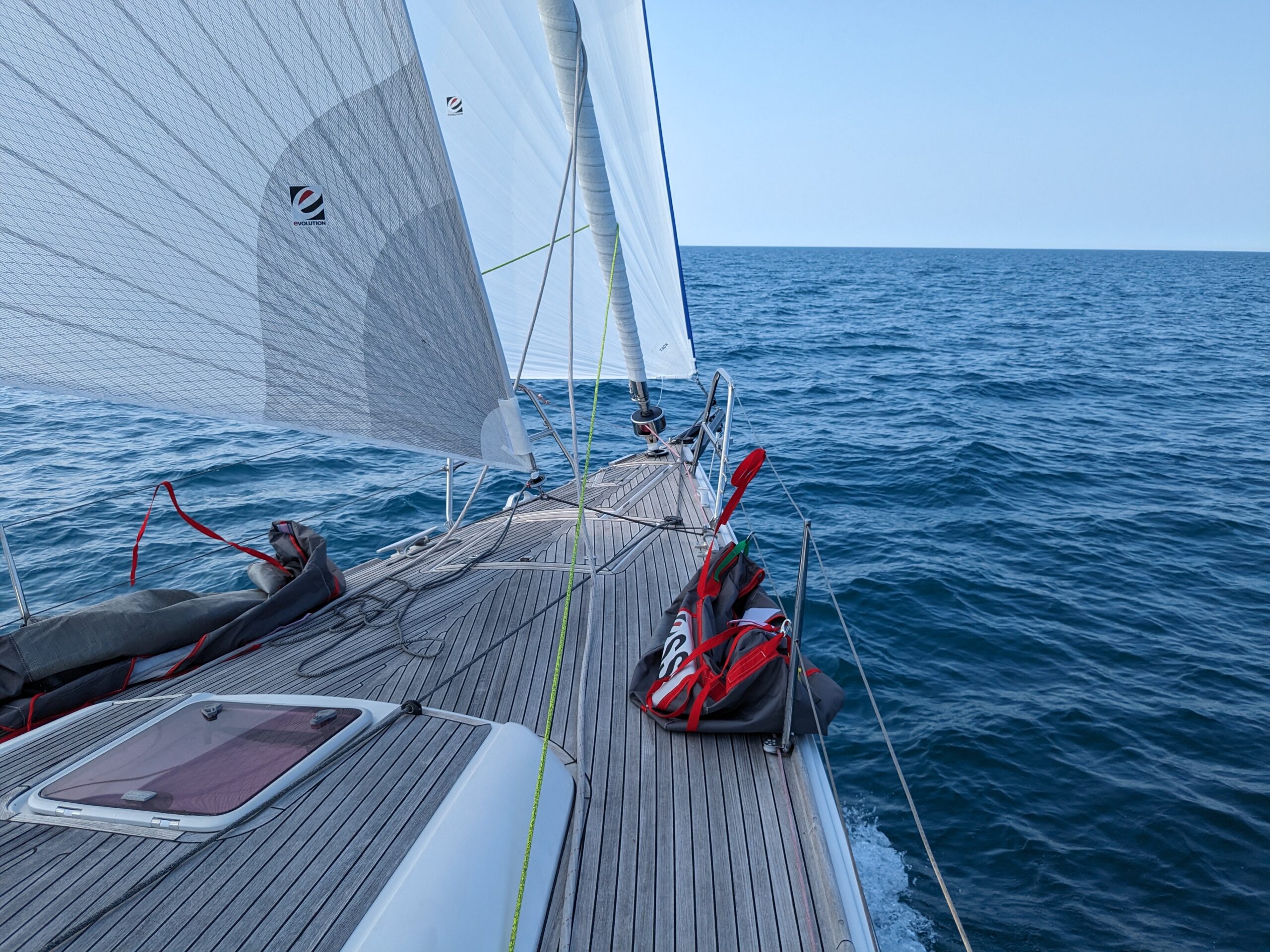
The Cruising divisions for the Chicago to Mackinac Race and the Bayview to Mackinac Race have taken off in recent years, offering a more approachable way to do one of the Great Lakes’ most iconic distance races. These divisions allow the use of autopilots and place limits on sail inventories and equipment, which significantly reduces both cost and complexity. Fewer sails, fewer changes, and a more manageable workload make for a very different experience than fully crewed handicap racing.
Just as importantly, the Cruising divisions open the door for boats that may not be competitive against purpose-built race boats. Heavier displacement boats with full interiors, furling sails, and conservative deck layouts can still be set up effectively and sail well within the rules. The emphasis shifts away from constant sail handling and toward smart preparation, good sail selection, and steady execution over a long race.
In this article, we will first walk through how the Cruising rules work for both races, then dive into how to set a boat up correctly, from bowsprit sizing to building the right sail inventory.
Overview of the Cruising Rules
For the purposes of this discussion, we are looking specifically at the Chicago to Mackinac Cruising Monohull Division and the Bayview to Mackinac Cruiser–Racer Division. Both are written around boats that are generally considered cruising-oriented, with heavier displacement, larger interiors, and more conservative sail inventories.
From a setup standpoint, the core rules are very similar. Both races require asymmetrical spinnakers, limit the spinnaker tack point to 125 percent of J, and prohibit flying headsails. Boats are limited to two spinnakers and two headsails, with storm sails excluded from those limits. Code Zeros are allowed only if they measure as spinnakers, which effectively removes very flat, jib-like sails from the inventory and keeps boats within the spirit of the Cruising divisions.
Chicago requires headsails to be rigged on roller furling gear, while Bayview allows headsails to be set on hanks or a conventional headfoil. In both races, boats are limited to carrying two headsails, though taking a roller furler credit under ORC reduces that limit to a single headsail. Storm sails required by the safety regulations are exempt and do not count toward the sail limits.
The only meaningful difference between the two races is the treatment of staysails. Chicago explicitly allows staysails, including their use alongside a spinnaker, provided they are declared on the ORC certificate and comply with ORC staysail rules. Bayview, by contrast, prohibits more than one sail forward of the mast on sloops, which effectively eliminates staysails as a performance tool. For boats planning to do both races, this difference is easy to manage by simply adding or removing staysails from the inventory.
Setting Up a Boat for the Cruising Chicago to Mackinac Race
When setting a boat up for the Cruising Mackinac Races, it is important to remember that everyone is working within the same constraints and making the same compromises. Inventories are smaller than ideal, but every boat is subject to the same limits. The goal is to maximize usable sail area, particularly downwind, while choosing a combination of sails that covers the widest possible range of conditions and still rates well under ORC.
Getting the Bowsprit Right
The bowsprit is one of the most important pieces of the setup. The spinnaker tack point is limited to 125 percent of J, and in almost every case we recommend getting as close to that limit as possible. A longer bowsprit allows the boat to sail deeper downwind, supports a larger spinnaker, and adds horsepower, which most cruising-division boats need. The ORC penalty for additional sprit length is relatively small compared to the real-world performance gain.
On Chicago boats that carry staysails, a longer sprit also improves staysail geometry and allows those sails to be flown more effectively in light air without interfering with the spinnaker. For boats under forty feet, Selden bowsprits are a proven and cost-effective option. Trogear sprits work extremely well across a wide range of boats, particularly those over thirty-five feet, though they do come at a higher price point.
Spinnaker Selection

Spinnaker selection is where most of the performance potential lies, and with only two spinnakers allowed, those choices matter.
For most boats, the foundation of the inventory is an all-purpose A2. The Mackinac races are generally downwind and often light air. The A2 is the workhorse sail running and broad reaching sail that can be cut to work across a wide range of conditions, especially on the lighter side of the wind range. The A2 will be your most used spinnaker and the first one we recommend for the race.
For boats with smaller headsails, especially jib-only boats, a Code Zero can be extremely valuable. Under the Cruising rules, Code Zeros must measure as spinnakers, which makes them best suited for tight and beam reaching rather than true upwind sailing (click here for more information on mid girths). The ability to maintain speed on tight reaches in light air is critical, and a well-designed Code Zero fills that role effectively. We strongly recommend furling Code Zeros for ease of handling, and in our experience Karver furlers have worked very well for this application.
The other spinnaker commonly considered is an A3, which is a dedicated reaching asymmetric. An A3 is generally smaller and heavier than an A2 and is designed to remain stable at higher apparent wind angles. In terms of usage, it sits between an A2 and a Code Zero. On boats that already carry a large genoa and are well powered up on reaches, an A3 often makes more sense than a Code Zero. Since a Code Zero functions similarly to a large genoa, boats with powerful overlapping headsails tend to benefit more from an A3 to extend their reaching range as the breeze builds.
Headsail Strategy
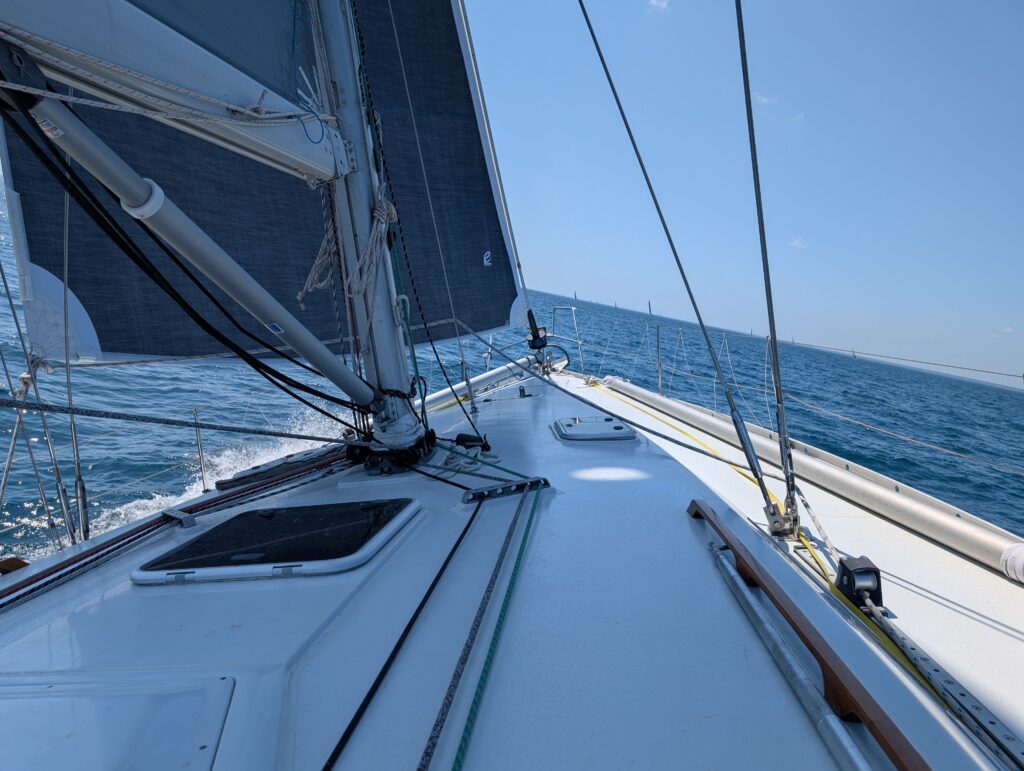
Headsail strategy depends heavily on how the boat is configured. Boats are limited to two headsails, and under ORC rules, claiming a roller furler credit further limits the boat to a single headsail. This can be a good option for boats that do not plan to do sail changes or want to keep the inventory as simple as possible.
For boats set up without overlapping genoas, an all-purpose jib is usually the backbone of the inventory. We generally recommend maximizing sail area, typically in the range of 105 to 110 percent LP, to ensure the boat has enough horsepower. Traditional jib leads are preferred over self-tacking setups, which tend to give up both sail area and shape control. On these boats, the Code Zero usually fills the light-air upwind and tight-reaching role.
Boats that carry genoas require a more nuanced approach. While a 155 percent LP genoa is common in racing inventories, many cruising boats are not designed to benefit from a sail that large, and the associated rating hit can outweigh the performance gain. In many cases, reducing the genoa size to something in the 135 to 140 percent range and relying on the Code Zero for light-air work produces a better overall result. For these boats, a smaller blade jib often makes sense as the second headsail. With limited inventories, reducing sail area by reefing the mainsail is usually preferable to roller reefing the headsail, which compromises sail shape, particularly upwind.
Staysails (Chicago Only)

Chicago’s allowance for staysails opens up additional options for boats looking to extract more performance without a rating penalty. A spinnaker staysail can add meaningful speed when broad reaching or running, particularly once boatspeed exceeds eight knots. These light, free-flying sails typically tack partway aft of the bowsprit and hoist on the spinnaker halyard. Using a small furler makes them far easier to manage, allowing the sail to be furled during maneuvers and redeployed cleanly.
A genoa staysail is less common in the Cruising division but can be effective on boats that need additional area. These sails tack further aft, hoist on a lower halyard, and are sheeted more like jibs. They are flatter and stronger than spinnaker staysails and are generally used when reaching under a genoa or Code Zero. On the right boat, they can add a few tenths of a knot in conditions where every bit of power matters.
Final Thoughts
The Cruising divisions of the Chicago to Mackinac and Bayview to Mackinac races are not about watering down the challenge. They are about shifting the emphasis from constant sail handling and large inventories to thoughtful preparation, smart sail selection, and efficient execution over a long distance race. The rules create a level playing field by limiting sail counts and sail types, which means performance gains come from making good decisions before the dock lines are cast, not from carrying every possible option on board.
When boats are set up correctly, the Cruising divisions can be just as rewarding as any other class. Maximizing bowsprit length within the rules, choosing the right combination of spinnakers, and building a headsail inventory that balances power, rating, and handling all make a measurable difference. For Chicago boats, staysails add another layer of opportunity, while Bayview rewards clean, simple sail plans that are easy to manage in changing conditions.
Perhaps most importantly, these divisions make the Mackinac races accessible to a broader range of boats and crews. With fewer sail changes, lower costs, and the ability to use autopilots, teams can focus on sailing the boat well, staying rested, and enjoying the experience. A well-prepared cruising boat, sailed consistently, can be surprisingly fast and very competitive over the course of the race.
For more information
If you are interested in talking about your sails before the Cruising Mac or want to understand how additional sails it could improve your race, we would be happy to help.
Request a Quote
Quote
Learn More About Evolution Sails Chicago
Evolution Sails Chicago
Explore Our Learning Center
Learning Center
See Our J Boats Midwest Dealership
J Boats Midwest