

This article started the same way many great sailing discussions do, as a bit of Yachty Karate in the loft after a race. One of the guys had gotten pinned behind a slower boat in a beercan race and was talking through how to get around them. With mixed fleet racing becoming more common in PHRF, ORC, ORR, and IRC, these situations matter. If you come from a one design background, some of these concepts may feel foreign, but they are essential tools for improving your results in handicap racing. And many of these techniques translate directly into one design racing as well.
The most important mindset shift is understanding that handicap racing is a time trial. The other boats on the water are obstacles, not opponents in the same tactical sense as one design racing. You can beat a boat without ever passing it physically, and you can lose to a boat that never comes near you. The key is minimizing time lost. That requires knowing what the other boats are capable of, how your boat compares, and how to position yourself to avoid getting slowed down.
Sailing your boat to its numbers becomes critical. You may be racing boats that are nowhere near you on the course or sailing in different breeze altogether. Focus on your shifts, your targets, and your sail trim. When you end up next to boats that are not in your section, your goal is simply to get by with the least impact. I have even cleared out of the way intentionally to let a faster boat roll through quickly so we could get back to sailing our own race without being bogged down in their dirty air.
Knowing the characteristics of the boats around you makes a huge difference. A light sportboat may be quick downwind and slow upwind. In that case, stay close upwind, then set up your passing lanes for the run. If you are sailing a symmetrical boat around asymmetricals, you will want to stay to leeward so they cannot heat up and force you onto their angle. If you have a big genoa and a lower pointing mode than modern jib boats with inhaulers, you may need to set up to leeward at the start to avoid being squeezed off by boats that can outpoint you. In one design terms, that juicy lane you are used to may disappear because the boats on either side sail different angles.
Boat speed still matters, and your exit plan off the start becomes more important. As a slower boat, you may prioritize getting a clean lane and staying away from boats that will roll you. Keep your head on a swivel and anticipate when a faster boat is coming up behind you. Sometimes the safest move is to tack or gybe out early before their dirty air becomes a problem. As a faster boat, life is easier, but the penalties for getting stuck behind someone are greater. Every second spent going slow is time lost against the clock. If you get trapped, do not wait too long to break away and find a clean lane.
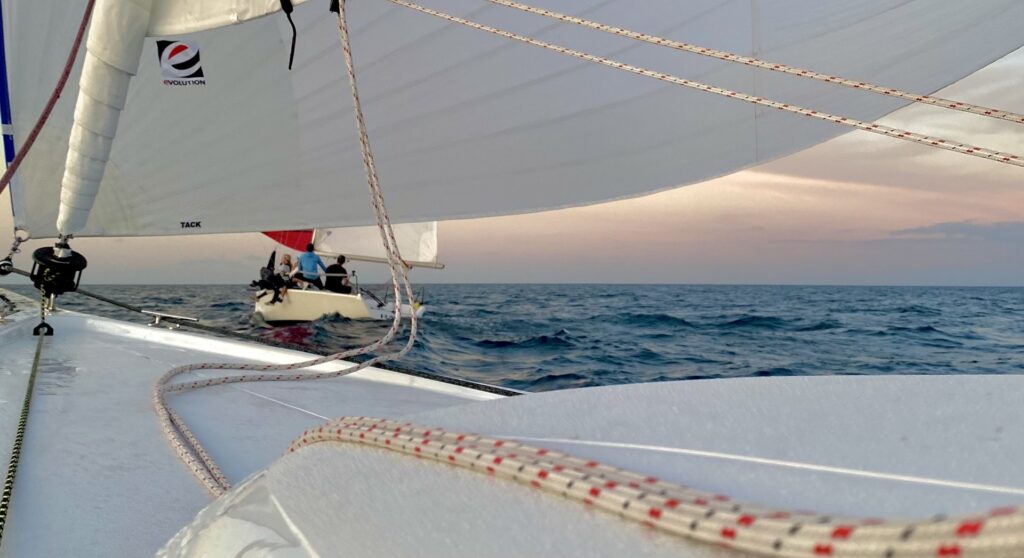
Knowing your own boat becomes far more important than in one design. You do not have another identical boat next to you providing instant feedback. You will need to rely on polars, instruments, and feel to make sure the boat is at max speed. This is especially hard when you are sailing alone or around much slower boats because it is easy to get complacent. Sail selection also becomes trickier. The boat ahead may not have a kite set because they only have symmetrical sails, but your asymmetrical might be perfect for that angle. A heavy boat might hold onto their big genoa longer, while your lighter boat may need to downsize earlier. Without other comparable boats nearby, you need a clear understanding of your own sail chart.
When passing or being passed, the goal is simple, lose as little time as possible. Boats of similar speed are the most disruptive because you stay in each other’s bad air longer. If you are overtaking a boat, choose your passing lane early. To pass to weather, climb well above them before engaging so they are less tempted to luff. To pass to leeward, think about your wind shadow and the angles where your boat is fast. Establish your lane early so you can punch through their dirty air quickly.
When being passed, minimize the damage. If you need to show the boat behind where you want them to go, for example bowing up slightly to signal you prefer them to pass to leeward, do it early. If they insist on going over the top, sometimes it is better to return to your course and accept a short period of dirty air rather than sailing high and slow for a long time. If you regularly race in the same fleet, you will learn tendencies. Our local T 10 fleet, for example, loves to take people up when trying to pass, so getting separation early can save you a lot of trouble.
Mark roundings amplify all of these concerns. Coming into a crowded rounding, ask yourself whether the big poorly sailed boat is going to cause chaos on the turn or whether there is a boat that can outpoint us arriving at the layline at the same time. Sometimes the smartest play is delaying slightly to get an inside track on a problematic boat. Sometimes you sail an extra length to avoid getting pinned or rolled. Even in one design, the goal around marks is always the same, get around with the least pain, not necessarily by exercising every possible right of way privilege.
Mixed fleet racing presents unique tactical challenges, but mastering these concepts can transform your results. Winning is about sailing the fastest course with the least interference from others. Sometimes that means letting someone pass with minimal disruption. Sometimes it means breaking off to sail your own race. Understanding how to manage the boats around you will help you climb the results sheet and give you plenty of new material for the next round of Yachty Karate in the loft.
Summary
Handicap racing requires a different mindset than one design. Success comes from treating the race as a time trial, understanding the strengths and weaknesses of the boats around you, and minimizing time lost when passing or being passed. Knowing your own polars, sail selection, and performance characteristics becomes essential. Use these strategies to navigate mixed fleets cleanly, protect your time, and sail your best race regardless of who is around you on the course.
Learn More
If you want help optimizing your boat speed, sail selection, or mixed fleet performance, we would love to work with you.
Request a Quote
Quote
Learn More About Evolution Sails Chicago
Evolution Sails Chicago
Explore Our Learning Center
Learning Center
See Our J Boats Midwest Dealership
J Boats Midwest